Art and the New Ecology
How making art can help us heal our relationship with nature
Last summer I taught a workshop called "Lessons from Flowers." I didn't really know how these sessions were going to turn out. I only knew I was driven to communicate one thing - the power of art to connect us with nature. Flowers are a perfect subject to work with to experience this for yourself. They are one of those tiny details, that we take for granted, but that brighten our world in both subtle and flamboyant ways. Like much of nature, we treat them like a backdrop, a decoration on the stage of our human drama. They have been a part of our lives since birth, yet how well do we really know them? How well do we know the bends and turns of the old oak at the park or the delicate stems of the tiny purple flowers that pop up in the front yard in spring? Since our culture is not focused on these forms of life, we learn to ignore them in favor of the tools that seem to more directly support our daily survival - cars, phones, screens, and the endless array of items we purchase to fill our spaces and our minds. With our attention so uniquely and intensely directed toward inanimate objects, we come to see living things as lifeless objects as well. Without realizing it, we inherit an inability to sense the living energy of the ecosystems that sustains us. We act as self-contained figures, moving around in world of raw materials to be acquired and manipulated to suit our priorities, and ours alone.
One way this manifests is through the phenomenon known as « plant blindness » Plant blindness is defined as « the inability to see or notice plants in one’s own environment. » The reason for this is evolutionary. Our brains needed to prioritize attention to animals since their rapid movement made them an immediate threat. However, the conditions of modern society that have greatly reduced our physical contact with nature have exacerbated this bias to a point where it has become harmful to our mental and physical health and even a threat to the sustainability of our species. It’s not hard to imagine how a lack of basic awareness of the organisms that make up 80% of all biomass on earth could indeed cause serious problems.
"Art is no less than a way for humans to practice getting out of their own way in order to sense and move with the rhythms of nature."
A species that sees itself as existing independent of its biological ecosphere is obviously going to make decisions that will eventually work against its very survival. We are currently witnessing the unfolding of this phenomenon as we continue to take carbon out of the ground and refuse to take any action on a global scale to curb the amount of carbon dioxide released into the atmosphere. Even the timid but instant rejuvenation of plant and animal life we witnessed all over the world during the brief time that global activity came to all halt during the Covid pandemic was not enough to make us truly realize the harm we are causing or inspire care for the living planet we call home. The self-awareness that makes us unique among animals may not be the gift we think it is if it causes us to live at odds with the rest of nature, awkwardly stepping on our own feet while the rest of the earth’s creatures whirl in a graceful ballet. We have ruined the dance, setting off a mass extinction without even really grasping the implications. John Haines writes, « A degraded land inevitably produces a degraded people. It is in fact ourselves we are destroying. »
The only way humans can save themselves is to do the one thing that they have refused to do throughout their existence - work together as a species. Only through organized, consistent global action to adopt values that require us all to work in concert with nature, will we be able to save our world. This requires change at a level that seems beyond our ability to affect as everyday citizens. Where does this leave us as individuals, now that we all understand that recycling our yogurt cup is not going to save us? We still make the efforts we can make - advocacy, community work - but deep down we often have a sense that these things will not be enough without transformation on a broader scale. This leads to a vague sense of hopelessness and frustration, that eventually turns to resignation, as we just keep up the daily task of making some kind of effort, no matter how small it may seem. However, there are also opportunities to work within the sphere of influence that we do have, starting with our inner world, our own perceptions and beliefs, our own relationship with nature. This is where making art can help. Exploring the world around us through a creative lens opens our awareness to the fragility of life and fosters a personal and deep connection with the life forms that share our space.
You can try this for yourself. Choose a natural element from your surroundings--flower, a feather, a leaf, whatever you find. Now draw or paint it. How did you feel about that item before you drew it? How do you feel about it now? As I was gathering ideas for my last workshop, I watched the flowers. I listened to them. I painted them and studied how others before me had painted them. And this is what they told me - humans will not know how to live in this world until they are able to truly see nature--until they see the plants, the animals, the living world-- truly see, not just with their eyes but with their hearts. Until they see that the world is alive and that they are part of the great aliveness that is the earth, they will not be able to truly thrive in it.
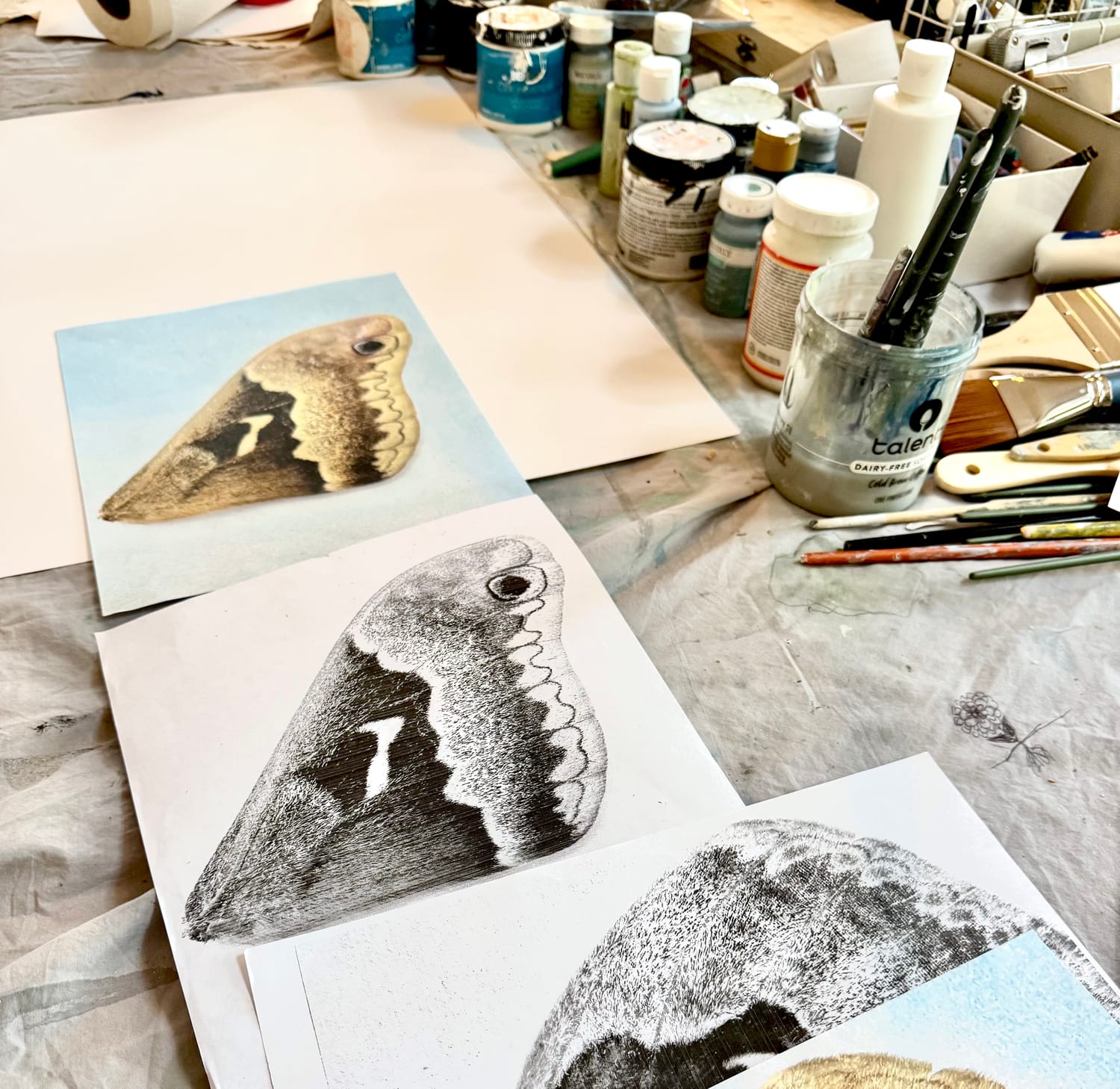
That is why art is more important than ever in this moment - it is one of the only things that can help humans practice getting out of their own way to sense and move with the rhythms of nature. It is our way of learning the dance. Frederick Frank explains, "I have learned that what I have not drawn, I have never really seen, and that when I start drawing an ordinary thing, I realize how extraordinary it is, sheer miracle."
Is changing our core values as a culture even possible at this stage of the game? I don’t know. But our ability to do this is imperative if we are to have any chance at making systemic change. Without developing a deeper relationship with nature, we will not have the knowledge or empathy to motivate us to make the necessary transitions. We have already seen that fear and ignorance will not get us where we need to go. Changes made from our current mindset end up being superficial or temporary at best, as many who already possess a profound relationship and love for the earth have seen. I truly believe, however, that by practicing and celebrating art that brings us into direct interaction with nature, we can begin the healing process at the soul level. Even if this can't ultimately save us, what better way to spend our time here than by learning from nature and discovering her mysteries? What better reason to make art than to fully experience a sense of connection and belonging to the web of life? It's not too late to realize the sheer miracle.
Join me for "Lessons from the Ocean" July 11, 18, and 25.
Newsletter
Get articles, activities, and resources to support your art and mindfulness practices.
© Marlowe Emerson, The Art Path, 2025. All rights reserved.
Built with ©systeme.io